|
|

|
|
|
|
|
|
|
| Click Here to See More Phonographs and Stands on Page 2 |
|
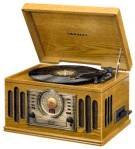
The defining feature of a good design is that it transcends time. The Conductor
antique replica phonograph
joins in the ranks of the Crosley vintage collection as one of the most timeless designs ever created. Built for
durability, this classic beauty combines handsome styling with all of today's modern conveniences. This
nostalgic musical
masterpiece features a cherry or paprika cabinet, analog AM/FM radio, 3-speed record player, compact disc player and a side
mounted cassette deck.
Click Here to see
it in Cherry.
Item # CR73CD CR73CD-CH (Cherry) ~ UPC:
710244277372 Free Shipping in the Continental USA! $159.99 |
 Click for larger view New |
|
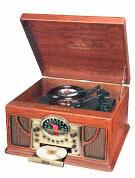
The 1940's were dominated primarily with World War II efforts. Women made an exodus from the home to the workplace, in an effort to replace men who had gone off to war. While wartime production pulled the U.S. out of the Great Depression, rationing still affected the food we ate, the clothes we wore, the toys with which children played and the lifestyle we kept. Radio became a lifeline for most Americans, providing news, music and entertainment. It was not uncommon for life to come to a screeching halt as literally hours were spent huddling in front of this humming box in the corner of the living room. Leave it to Crosley Radio to bring back a little nostalgia with the old vintage style BandMaster antique replica phonograph. The nostalgic BandMaster features Crosley's very own Stack-O-Matic technology allowing you to stack up to 6 records in the turntable record player and drop them automatically for continuous play. The analog AM/FM radio is handsomely showcased with an illuminated center dial while a dose of modern-day-technology includes a programmable CD Player with 20-track memory. Note: We do not recommend stacking 78's because of the age and thickness of them. Special Note: The CK-1 Cleaning Kit and the NP-1 Replacement Needle are not for use with the Stack-O-Matics. A special needle to fit the Stack-O-Matics is available as part number NS-1.
Item # CR86 UPC: 710244278614 Free Shipping in the Continental USA! $249.95 |
 Click for larger view New |
|
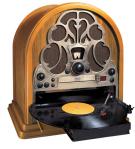
The nostalgic RCA radio / phonograph combo is a classic reproduction of the old vintage cathedral style radios. This beautiful antique replica entertainment center features an AM/FM radio, a front loading CD player and a 3 speed retractable turntable record player.
Item # RCA-MAGNOLIA UPC: 730233816689 Free Shipping in the Continental USA! $199.99 |
 Click for larger view New |
|
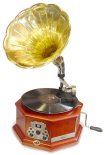
This nostalgic entertainment center is a beautiful reproduction of the old antique RCA Victrola phonograph. The horn and turntable sit atop an octagonal wooden base. This vintage replica Victrola features an AM/FM analog radio, front loading CD player, 3 speed turntable record player and an optional stand. (See page 2 for stands). Click Here to see it on the optional stand.
Item # RCA-LAWTON UPC: 730233-816627 Free Shipping in the Continental USA! $179.99 |
 Click for larger view New |
|
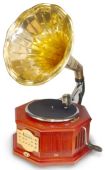
This nostalgic entertainment center is a beautiful antique reproduction of the old nostalgic RCA Victrola phonograph. The horn and turntable sit atop an octagonal wooden base. This vintage Victrola replica features an AM/FM digital radio, front loading CD player, 3 speed turntable record player, remote control, and an optional stand. (See page 2 for stands).
Item # RCA-NEWPORT UPC: 730233816603 Free Shipping in the Continental USA! $189.99 |
 Click for larger view New |
|
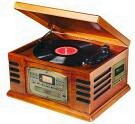
Antique style entertainment center with Logic Deck Cassette Recorder. The vintage CR79CD replica phonograph combines digital AM/FM radio with front loading CD player, side mounted cassette player / recorder and a 3 speed turntable record player. At last you can make direct recordings to cassette of your favorite CDs, LP albums, or even those rare and valuable 45 rpm or 78 rpm records. Click Here to see it in Oak.
Item # CR79CD CR79CD-OA (Oak) ~ UPC: 710244277969 Free Shipping in the Continental USA! $219.99 |
 Click for larger view New |
|
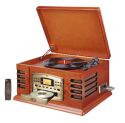
Antique style entertainment center with cassette player. The vintage CR78CD replica phonograph combines digital AM/FM radio with front loading CD player, side mounted cassette player and a 3 speed turntable record player. Click Here to see it in Oak.
Item # CR78CD CR78CD-CH (Cherry) ~ UPC:
710244277884 Free Shipping in the Continental USA! $219.99 |
 Click for larger view |
|
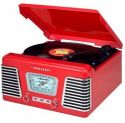
The AutoRama replica phonograph represents a vintage icon mimicking the clean, streamlined stylings of a classic 1950's automobile. From the sleek illuminated center dial, to the chrome grill side mounted speakers, this beauty takes you back to the days of drive ins and diners. Crosley's fascination with automobiles is evident right down to the last exacting detail. This nostalgic AutoRama phonograph features an AM/FM Radio, a 3-speed turntable record player and enough sophistication to render most enthusiasts speechless. Available in red, black and now in brushed chrome. Click Here to see it in Black. Click Here to see it in Brushed Chrome. Phonograph Features:
Item # CR711 CR711-BK (Black) ~ UPC: 710244277129 Free Shipping in the Continental USA! (Red and Black) $109.99 * * * * * New (Brushed Chrome) $119.99 |
 Click for larger view |
|
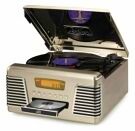
Mimicking the clean, streamlined styling of a classic 1950's automobile this vintage replica phonograph takes you back to the days of drive-ins and diners. The nostalgic AutoRama CD features an AM/FM Radio, a 3 speed turntable record player, a front loading compact disc player and enough sophistication to render most enthusiasts speechless. Click Here to see it in Black. Click Here to see it in Red. Phonograph Features:
Item # CR712 CR712-BK (Black) ~ UPC: 710244277174
Free Shipping in the Continental USA! (Red and Black) $169.99 * * * * * (Brushed Chrome) $179.99 |
 Click for larger view New |
| Click Here to See More Phonographs and Stands on Page 2 |
The phonograph, or gramophone, was the most common device for playing recorded sound from the 1870s through the 1980s.
Usage of these terms is somewhat different in American English and British English; see usage note below. In more modern usage, this device is often called a turntable or record player. In the late 19th and early 20th century, the alternative term talking machine was sometimes used. The phonograph was the first device for recording and replaying sound.
In more modern usage, this device is called a turntable or record player.
The term phonograph meaning "writing sound", is derived from Greek roots. Similar related terms gramophone and graphophone have similar root meanings.
Arguably, any device used to record sound or reproduce recorded sound could be called a type of "phonograph", but in common practice it has come to mean historic technologies of sound recording.
The earliest known invention of a phonographic recording device was the phonautograph, invented by Leon Scott and patented on March 25, 1857. It could transcribe sound to a visible medium, but had no means to play back the sound after it was recorded. The device consisted of a horn that focused sound waves onto a membrane to which a hog's bristle was attached, causing the bristle to move and enabling it to inscribe a visual medium. Initially, the phonautograph made recordings onto a lamp-blackened glass plate. A later version used a medium of lamp-blackened paper on a drum or cylinder—an arrangement to which Thomas Edison's later invention would bear striking resemblance. Other versions would draw a line representing the sound wave on to a roll of paper. The phonautograph was a laboratory curiosity for the study of acoustics. It was used to determine the vibrations per second for a musical pitch and to study sound and speech; it was not widely understood until after the development of the phonograph that the waveform recorded by the phonautograph was a record of the sound wavelength that needed only a playback mechanism to reproduce the sound.
Patent drawing for Edison's phonograph, 05/18/1880.Thomas Alva Edison announced his invention of the first phonograph, a device for recording and replaying sound, on November 21, 1877 and he demonstrated the device for the first time on November 29 (he patented it on February 19, 1878; US Pat. No. 200,521). Edison's early phonographs recorded on a phonograph cylinder using up-down (vertical) motion of the stylus. Edison's early patents show that he also considered that sound could also be recorded as a spiral on a disc, but Edison concentrated his efforts on cylinders, since the groove on the outside of a rotating cylinder provides a constant velocity to the stylus in the groove, which Edison considered more "scientifically correct". Edison's patent specified that the audio recording was embossed, and it was not until 1889 that engraved recordings were patented by Bell and Tainter.
Emile Berliner invented what he called the Gramophone, another device for recording and replaying sound, and patented it in on November 8, 1887 (US Pat. No 372,786). It recorded on a disk using side-to-side (lateral) motion of the stylus.
In British English "gramophone" came to refer to any sound reproducing machine using disc records, as disc records were popularized in the UK by the Gramophone Company. The term "phonograph" is usually restricted to devices playing cylinder records.
In American English, "phonograph" was the most common generic term for any early sound reproducing machine. Berliner's Gramophone was considered a type of phonograph. "Gramophone" was a brand name, and as such in the same category as "Victrola," "Zon-o-phone," and "Graphonola" referring to specific brands of sound reproducing machines.
The brand "Gramophone" was not used in the USA after 1901, and the word fell out of use there. In contemporary American usage "phonograph" most usually refers to disc record machines or turntables, the most common type of analogue recording from the 1910s on. The word has survived in America based on its nickname form, "Grammy", in the Grammy Awards.
Disc recording is inherently neither better nor worse than cylinder recording in potential audio fidelity.
Recordings made on a cylinder remain at a constant radial velocity for the entirety of the recording, while those made on a disc, have a higher radial velocity at the outer portion of the groove, compared to the inner portion.
Edison's patented recording method recorded with vertical modulations in a groove, Berliner utilized a lateraly modulated groove.
Though Edison's recording technology was better than Berliner's, there were commercial advantages to a disc system:
The disc could be easily mass produced by molding and stamping, and required storage space for a collection of recordings. The heavy cast-iron turntable acted as a flywheel and helped to maintain a consistent rotational velocity. The cylinder machine, lacking this greater rotational inertia, was susceptible to musical pitch fluctuations, and required more mechanical adjustment and maintenance to avoid this impairment. Berliner successfully argued that his technology was different enough from Edison's that he did not need to pay royalties on it, which reduced his business expenses.
Through experimentation, in 1892 Berliner began commercial production of his disc records, and "gramophones" or "talking-machines". His "gramophone record" was the first disc record to be offered to the public. They were five inches (12.7 cm) in diameter and recorded on one side only. Seven-inch (17.8 cm) records followed in 1895. By 1901, ten-inch (25.4 cm) records being sold by the Victor Talking Machine Company, and Berliner had sold his interests. By 1908, double sided disc recorded records became demanded by the public, and cylinders fell into disfavor. Edison felt the commercial pressure for disc records, and by 1912, though reluctant at first, his movement to disc records was in full swing.
From the mid 1890s until the late 1910s both phonograph cylinder and disc recordings and machines to play them on were widely mass marketed and sold. The disc system gradually became more popular due to its cheaper price and better marketing by disc record companies.
From 1900, through the early 1920s, cylinder records, disc records, and machines to play them, were widely mass marketed and sold, and was considered the ultimate in fine home entertainment. Edison ceased cylinder manufacture in the fall of 1929, and the history of disc and cylinder rivalry was concluded; and engraved to disc.
Berliner's lateral disc record was the ancestor of the 78rpm, 45rpm, 33⅓rpm, and all other analogue disc records popular for use in sound recording through the 20th century. See gramophone record and vinyl record.
Christmas 1925 brought improved radio technology and radio sales, and many phonograph dealers to financial ruin. With efforts at improved audio fidelity, the big record companies succeeded in keeping business booming through the end of the decade, but the record sales plummeted during the Great Depression, with many companies merging or going out of business. Booms in record sales returned after World War II.
The "phonograph", "gramophone" or "turntable", remained a common element of home audio systems well after the introduction of other media such as audio tape and even the early years of the compact disc. They were not uncommon in home audio systems into the early 1990s.
The technology of required for a turntable is simple. Most designs use a belt drive or direct drive system. Earlier designs also used an indirect drive system using a rubberized wheel, however, non-linear wear, and decomposition of the wheel introduced noise, and speed variations into the desired audio. These systems generally used a synchronous motor which ran at a speed synchronized to the frequency of the utility supplier. Different speeds were obtained by bringing differing diameter wheels into position between the drive and the platter.
The belt drive improved motor and platter isolation, this noise transfer (usually heard as low frequency rumble) was much reduced. It is difficult to design comprehensive multiple speed synchronous motors, consequently, DC motors, with electronics providing speed control, have gained favor. On the most sophisticated designs, sensors on the platter, are used to ensure the speed of the platter remains locked and absolutely stable. Many platters have a continuous series of reflective markings machined around their edge to provide these pulses. A strobing effect can be observed by the operator to verify rotational speed. Basic DC motors tend to rotate in steps rather than smoothly, this is referred to as 'cogging', and can add noise during playback. Helical armature motors can be used to overcome this.
Direct drive turntables, drive the platter directly, without utilizing intermediate wheels or belts as part of a drive train. The platter functions as a motor armature. This requires good engineering, with advanced electronics for acceleration and speed control. This design and is integrated into some of the finest systems available.
"Turn Tables" or "Turntablism" is not considered by some as a musical instrument, as it is a 'technique' of manipulating music as laid down by artists. However, music may be defined as an 'organized sound', and organized manipulation of sound (music) is still music.
His Master's Voice, often abbreviated to HMV, is a famous trademark in the music business, and for many years was the name of a large record company. The name was coined in 1899 as the title of a painting of the dog Nipper listening to a wind-up gramophone.
The famous trademark image came from a painting originally titled Dog looking at and listening to a Phonograph, and then retitled His Master's Voice. It was painted by British artist Francis Barraud in 1898, based on memories of his dog Nipper. The original version of the painting showed not the disc gramophone familiar in the trademark today, but rather a cylinder phonograph. The dog and phonograph were perched atop a coffin. Presumably the dog was listening to the voice of his deceased owner. (This made more sense with a cylinder phonograph, since at the time they commonly had attachments to make home recordings, whereas the disc gramophone only played back prerecorded sound.)
Barraud failed to sell it to any cylinder phonograph company, but in 1899 was able to sell it to the Gramophone Company under the condition that he modify it to show a disc machine. The Gramophone Company first used the image on publicity material in 1900. At the request of the gramophone's inventor Emile Berliner, the American rights to the picture became owned by the Victor Talking Machine Company.
Victor used the image more aggressively than its U.K. partner, and from 1902 on all Victor records had a simplified drawing of the dog and gramophone from Barraud's painting on their label. Magazine advertisements urged record buyers to "Look for the dog".
In Commonwealth countries, the Gramophone Company did not use this design on its record labels until 1909. The following year the Gramophone Company replaced the Recording Angel trademark in the upper half of the record labels by the famous picture painted by Frances Barraud, commonly referred to as Nipper or The Dog. The Company was never called "HMV" or His Master's Voice, but was identified by that term because of its use of the trademark. Records issued by the Company before February 1908 were generally referred to as "G&Ts;", while those after that date are usually called HMV records.
This image continued to be used as a trademark by Victor in the USA, Canada and Latin America, and then by Victor's successor RCA. In Commonwealth countries (except Canada) it was used by the associated company HMV Records, which was later acquired by EMI. The trademark's ownership is divided between different companies in different countries, reducing its value in the globalised music market. The name HMV is used by a chain of music shops, mainly in the UK, Canada and Japan.
In 1921 the His Master's Voice Company opened the first HMV shop in London. In 1929 RCA bought Victor, and with it a major shareholding in the Gramophone Company which Victor had owned since 1920. In 1931 RCA was instrumental in the creation of EMI, which continued to own the "His Master's Voice" name and image in the UK. In 1935 RCA sold its stake in EMI but continued to own Victor and the American rights to His Master's Voice. World War II fragmented the ownership of the name still further, as RCA Victor's Japanese subsidiary The Victor Company of Japan JVC became independent. Nipper continued to appear on RCA Victor records in America while EMI owned the His Master's Voice label and shops in the UK until the 1980s. The globalised market for CDs pushed EMI into abandoning the HMV label in favor of "EMI Classics", a name they could use worldwide. Meanwhile RCA went into a financial decline; The RCA Victor label (complete with the dog and gramophone image) is now licensed by RCA Records owner BMG-Bertelsmann from trademark owner General Electric, while RCA's consumer electronics business (still promoted by Nipper the dog) is owned by Thomson.
Over the years the HMV label for records was abandoned by EMI, only to be revived in the nineties for Morrissey recordings.
The name HMV is still used by their chain of record shops in the UK, which continued to expand internationally through the 1990s. In 1998 HMV Media was created as a separate company and bought the Waterstone's chain of bookshops, leaving EMI with a 43% stake. In 2002 it floated on the Stock Exchange as HMV Group plc, leaving EMI with only a token holding.
The Victor Talking Machine Company (1901 - 1929) was a United States corporation, the leading American producer of phonographs and phonograph records and one of the leading phonograph companies in the world at the time.
The company was incorporated in Camden, New Jersey in October of 1901 by Eldridge R. Johnson. It was created by merger and reorganization of two existing companies: Emile Berliner's Berliner Gramophone Company, which produced disc records, and Johnson's Consolidated Talking Machine Company, which produced machines for playing disc records. The company was named "The Victor" in honor of legal victories by Johnson and Berliner over Zonophone and others concerning their rights to patents on and distribution of their products.
Victor had the rights in the United States and Latin America to use the famous trademark of the dog Nipper listening to an early disc phonograph. (See also His Master's Voice.)
In 1901, the phonograph cylinder still dominated the market for recorded sound. Disc records and phonographs were widely considered to be little more than toys, for they were cheaper, less reliable and usually of lower audio fidelity than the cylinder records. Johnson embarked on efforts to change these perceptions. He built more reliable spring-wound phonographs out of durable materials and hired engineers to research improved sound for the recordings. Within a few years, Victor was producing records with some of the finest audio fidelity of the era.
After increasing the quality of disc records and phonographs, Johnson began an ambitious project to have the most prestigious singers and musicians of the day record for Victor Records, with exclusive agreements where possible. Often these artists demanded fees which the company could not hope to make up from sale of their records. Johnson shrewdly knew that he would get his money's worth in the long run in promotion of the Victor brand name. Many advertisements were printed mentioning by name the greatest names of music in the era, with the statement that they recorded only for Victor Records. As Johnson intended, much of the public assumed from this that Victor Records must be superior to cylinder records.
The Victor recordings by Enrico Caruso were particularly successful. They were often used by retailers to demonstrate Victor phonographs; Caruso's rich powerful low tenor voice highlighted the best range of audio fidelity of the early audio technology while being minimally affected by its defects. Even people who otherwise never listened to opera often owned a record or two of the great voice of Caruso. Caruso and Victor Records did much to boost each other's commercial popularity.
The origins of country music as we know it today can be traced to two seminal influences and a remarkable coincidence. Jimmie Rodgers and the Carter Family are considered the founders of country music and their songs were first captured at an historic recording session in Bristol, Tennessee on August 1, 1927 where Ralph Peer was the talent scout and sound recordist for Victor Records.
Victrola Model XVI, 1910sIn 1906, Johnson and his engineers designed a new line of phonographs with the turntable and amplifying horn tucked away inside a wooden cabinet. This was not done for reasons of audio fidelity, but for visual aesthetics. The intention was to produce a phonograph that looked less like a piece of machinery and more like a piece of furniture. These internal horn machines, trademarked with the name Victrola, were first marketed to the public in August of that year and were an immediate hit. Soon an extensive line of Victrolas was marketed, ranging from small tabletop models selling for $15, through many sizes and designs of cabinets intended to go with the decor of middle-class homes in the $100 to $250 range, up to $600 Chippendale and Queen Anne-style cabinets of fine wood with gold trim designed to look at home in elegant mansions. Victrolas became by far the most popular brand of home phonograph, and sold in great numbers until the end of the 1920s.
In 1925, Victor switched from the old acoustical or mechanical method of recording sound to the new microphone based electrical system developed by Western Electric. Victor called their version of the improved fidelity recording process "Orthophonic", and sold a line of new designs of phonographs to play these improved records, called "Orthophonic Victrolas". The large top-of- the-line "Credenza" models of Orthophonic Victrolas had a 6 foot long horn coiled inside the cabinet, and are often considered the high point of the development of the commercial wind-up phonograph, offering audio fidelity seldom matched by most home electric phonographs until some 30 years later.
In 1928, Johnson sold his controlling interest in Victor to the banking firm of Siegelman & Spyer, who in 1929 sold to the Radio Corporation of America, which then became known as the Radio-Victor Division of the Radio Corporation of America later RCA Victor.
These articles are licensed under the "GNU Free Documentation License". They use material from the Wikipedia articles; "Phonograph", "His Master's Voice" and "Victor Talking Machine Company".
| Click Here to See More Phonographs and Stands on Page 2 |

|
|
|
|
|
||||||
| Copyright © 2005 DCW Store. All rights reserved. | ||||||
| Privacy Policy Security Resources |